


Why Industrial Partition Walls Improve Safe Factory Workflow

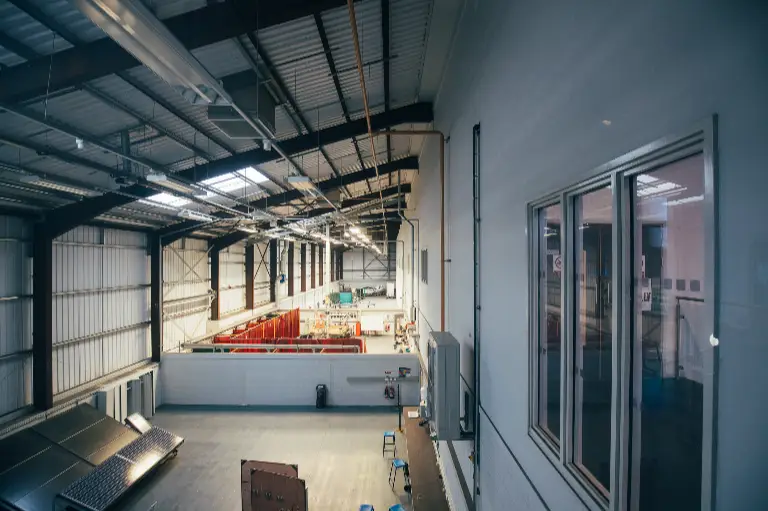
Why Industrial Partition Walls Improve Safe Factory Workflow
Manufacturing and warehouse facilities face growing pressure to meet safety compliance requirements, improve efficiency, and better use available space. As production increases, layouts often become congested, with pedestrian routes intersecting vehicle paths and safety controls harder to manage. In many cases, risk increases because space is not clearly organised.
Our industrial partition walls address this by separating people, machinery, and operational processes into defined zones. This supports safer movement, reduces unplanned interaction, and allows facilities to maintain consistent working practices in high-activity environments. When specified and installed correctly, industrial partition walls provide a clearer structure and improve daily workflows.
This article explains how partitioning supports safer factory layouts and more controlled, adaptable manufacturing environments.
What Industrial Partition Walls Do in Manufacturing Environments
Industrial partition walls are non-load-bearing internal systems that physically separate people, vehicles, and operational activities in factories, warehouses, and other industrial buildings. Their primary purpose is to support safe traffic management by creating controlled routes and clear physical boundaries in environments where pedestrians and vehicles operate closely together.
The Health and Safety Executive (HSE) states that employers have a legal duty to ensure pedestrians and vehicles can use traffic routes without endangering health or safety [1]. HSE guidance confirms that pedestrian and vehicle routes should be kept separate wherever reasonably practicable, with physical separation identified as the most effective method of reducing collision risk.
In practice, industrial partition walls are used to:
- Separate production areas
- Machinery zones
- Storage spaces
- Pedestrian walkways
They help keep vehicle routes away from pedestrian doors and access points, reducing the likelihood of people stepping directly into moving traffic. HSE guidance also highlights the need for barriers and clearly defined boundaries to manage risks such as limited visibility, noise masking vehicle movement, and materials falling from vehicles. Industrial partition walls support these controls by providing permanent, visible separation that complements signage, floor markings, and access restrictions.
The Role of Industrial Partition Walls in Workplace Safety
In manufacturing and warehouse environments, workplace safety is influenced by how facilities are designed to respond to incidents. HSE identifies plant layout as a critical factor in emergency access, evacuation planning, and limiting the escalation of hazardous events where multiple processes operate within the same site [2].
Industrial partition walls support these requirements by helping facilities maintain defined escape routes, restrict access to high-risk areas, and separate activities that could contribute to incident escalation. This reduces the likelihood that fire, loss of containment, or equipment failure in one area will affect adjacent operations.
HSE guidance also emphasises the importance of avoiding confinement and ensuring emergency services can access affected areas quickly. Well-planned partition layouts support these principles by maintaining navigable internal routes and clear compartmentation, contributing to safer evacuation and more effective incident response.
Create Clearer Movement, Coordination, & Control Across the Factory Floor
Workflow efficiency depends on how clearly space is organised and how consistently people and materials move through it. Poorly defined routes and overlapping activities can lead to congestion, delays, and avoidable safety risks that affect productivity and supervision.
Well-planned industrial partition walls support structured production and storage zones by creating physical separation between tasks and routes. This helps teams move more predictably through shared space and reduces unnecessary interaction between people, equipment, and materials.
- Defined routes for staff and material handling equipment
- Clear separation between production stages
- Fewer bottlenecks at key access points
- Improved supervision and task sequencing
- Easier housekeeping and standards control
These principles are central to organising storage, picking, and dispatch functions. Modern warehouse workplace design reflects this by prioritising layouts that support safe movement and operational efficiency across the site.
Types of Industrial Partition Walls Used in Manufacturing Facilities
Industrial partition walls come in several formats; each suited to different operational and risk requirements. Selecting the right system depends on how space is used, the level of exposure to impact or vehicle movement, and how often layouts may need to change.
- Steel partition systems are commonly specified in higher-risk or heavy-duty environments. Their strength and durability make them suitable for plant rooms, machinery zones, and areas where impact resistance is needed to protect people and equipment.
- Mesh partition walls are used where visibility and airflow are important. In warehouse and production settings, mesh systems enable equipment and stored goods to be supervised while maintaining physical separation and controlled access.
- Modular and demountable partition systems suit facilities expecting operational change. These systems allow layouts to be adjusted as processes evolve, helping minimise downtime when production methods or space requirements shift.
In many facilities, different partition systems are combined to address varying risks and functions across the same site without compromising overall layout coherence.
Why Compliant Design & Installation Cannot Be Treated as Optional
Industrial partition walls play a direct role in fire safety, internal compartmentation, and the provision of safe means of escape within non-domestic buildings. Their design and installation must align with building regulations to ensure fire resistance is maintained and evacuation routes remain protected.
Approved Document B sets out requirements for internal fire separation in buildings other than dwellings [3]. It explains how internal walls limit fire spread, protect escape routes, and maintain compartment integrity. It places the responsibility on designers to ensure partitions achieve the required fire performance and are correctly detailed at junctions and service penetrations.
A professional specification ensures partition walls integrate correctly with floors, ceilings, and building services. Poorly formed junctions or unprotected openings can significantly reduce fire performance.
Working with experienced fit out specialists helps facilities meet regulatory obligations, support safe evacuation, and integrate partitioning systems into the wider building layout without unnecessary disruption.
Speak to Jade Aden Interiors About Your Factory Layout
Effective industrial partitioning begins with understanding how people, processes, and equipment interact in a live manufacturing or warehouse environment. A structured review of layout, access routes, and operational risk helps identify where separation will improve safety and control without disrupting daily activity.
Jade Aden Interiors delivers industrial partition walls as part of wider commercial and industrial fit out projects. Our experience across manufacturing, warehouse, and technical settings allows layouts to be developed around operational realities, with a consultative focus on compliance, site safety, and long-term performance. Projects are delivered across Dorset, Hampshire, and the wider South of England.
Call 01425 689199 or book a consultation to review your factory or warehouse layout and discuss how industrial partition walls can help.
External Sources
[1] The Health and Safety Executive (HSE), “employers have a legal duty”: https://www.hse.gov.uk/workplacetransport/separating.htm
[2] The Health and Safety Executive (HSE), “plant layout”: https://www.hse.gov.uk/comah/sragtech/techmeasplantlay.htm
[3] GOV.UK, Building Regulations, “Approved Document B”: https://assets.publishing.service.gov.uk/media/67d17064a005e6f9841a1d50/Approved_Document_B_volume_2_Buildings_other_than_Dwellings_2019_edition_incorporating_2020_2022_and_2025_amendments_collated_with_2026_and_2029_amendments.pdf