


How Retail Mezzanine Floors Expand Usable Shop Space

How Retail Mezzanine Floors Expand Usable Shop Space
Retailers across the South of England and the Midlands are operating amid elevated costs, prompting many to reassess how effectively their current premises support day-to-day operations. According to the Office for National Statistics (ONS), UK inflation remained high in 2025, with CPIH rising by 3.8% in the 12 months to October 2025 [1].
Higher prices for goods and services affect retailers with physical locations, increasing the importance of making full use of available space. Many stores reach a point where stock rooms become crowded, customer flow is restricted, and fulfilment tasks compete for limited capacity.
Retail mezzanine floors provide a structured solution by converting unused headroom into a functional upper level for:
- Stock handling
- Customer activity
- Operational work
This guide explains how mezzanine floors expand capacity, support smoother operations and create clearer merchandising and service zones. It also outlines the design considerations and safety principles that help determine whether a mezzanine is suitable for your store.
Why Retailers Are Rethinking Space
Retailers are managing more activity within the same premises as store, online, and fulfilment operations overlap. The British Retail Consortium’s Retail in Numbers report shows that online sales accounted for 28% of all retail sales in September 2025, increasing the volume of orders processed through store-based fulfilment [2].
The same report notes that retail labour productivity in 2024 was 4.1% lower than in 2019, underscoring pressure on stock handling, staffing, and customer service. Layouts, therefore, need to support efficient workflows in restricted space, so that teams can manage multiple tasks within a fixed footprint.
Business rates are another consideration. The Valuation Office Agency updated rateable values for all non-domestic properties in England and Wales on 1 April 2023, and a further revaluation will take effect on 1 April 2026 [3]. These updates reflect changes in the property market and keep many retailers focused on making existing premises work harder before considering new sites.
In this context, a retail mezzanine floor converts unused headroom into functional space for stock, services or customer areas, helping businesses across the South of England and the Midlands gain more value from their current units.
What Are Retail Mezzanine Floors
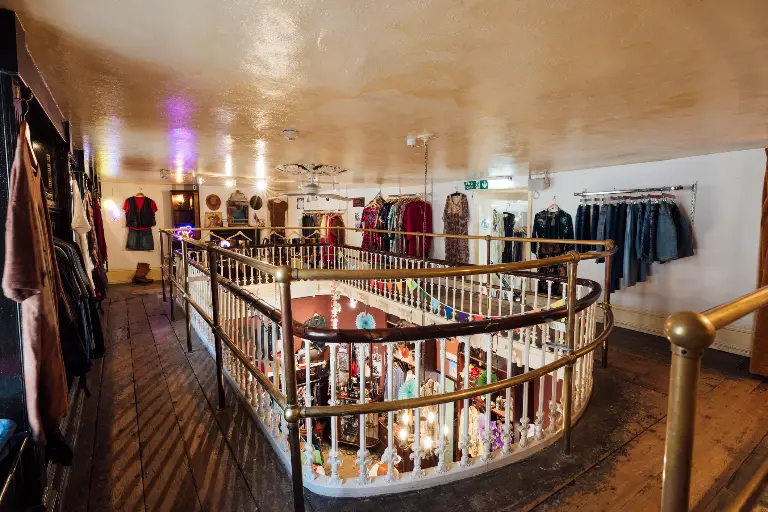
A retail mezzanine floor is a raised steel platform located within a building’s internal height. It creates an extra level of floor area for stock, customer activity or operational tasks. Decking and finishes are specified to suit either public footfall or storage loads, depending on the space’s intended use.
By introducing an additional tier, the mezzanine allows retailers to separate storage from sales space, or to add new merchandising and service zones above the main shop floor. Access routes, headroom, and safety features are planned as part of the design to ensure the new level supports day-to-day operations and meets relevant standards.
Retailers who would like to see how mezzanines look in completed projects can explore our gallery. The images show different layouts and demonstrate how additional levels integrate with lighting, branding and existing fixtures.
How Retail Mezzanine Floors Improve Operations and Customer Flow
Mezzanine floors help retailers organise stock, fulfilment and customer activity more effectively. The additional level provides teams with defined zones for tasks that would otherwise compete for space on the main shop floor. Back-of-house functions can move to the mezzanine, leaving the ground floor clearer for customers and key product ranges.
To make this practical, mezzanines can support:
- Stock rooms or buffer storage above the main sales area
- Click and collect or pick and pack zones that are separate from customer routes
- Seasonal storage for Christmas, promotions or sales events
- Quiet browsing areas, consultation zones or extended display space on an upper level
These layouts improve circulation and help teams maintain a consistent presentation standard. Customers have more room to move through the store, while staff have a more structured space for order preparation and stock handling. This is particularly useful for retailers expanding their online services while maintaining a strong in-store experience.
Safety, Design and Project Delivery
A mezzanine floor must support safe use for customers and staff, so compliance is built into the design process. Load capacity, fire strategy, access routes, and balustrade requirements are reviewed at an early stage to ensure the structure meets building regulations. This helps retailers understand how the new level will perform and how it will interact with daily operations.
Design planning considers headroom, stair position and visibility across both levels. These elements influence how easily customers can navigate the store and how clearly staff can monitor activity. Consistent lighting and coordinated finishes help the mezzanine feel integrated with the wider interior, creating a clean and professional retail environment.
Retailers who would like more details about structural design can visit our structural detail service page. The resource explains how columns, decking and load distribution support safe long-term use.
Transform Your Retail Space With Retail Mezzanine Floors
Retail mezzanine floors give retailers a structured way to increase capacity within existing premises. By turning headroom into additional floor area for stock, customer zones and operational tasks, they support long-term growth and a more organised store environment across the South of England and the Midlands.
Jade Aden Interiors provides a comprehensive mezzanine service covering planning, design, and installation, reducing the need for multiple contractors and supporting a predictable programme. The team assesses each site, develops layouts that meet operational and regulatory requirements, and delivers installations that integrate with the wider retail interior. Project videos on our website showcase how mezzanine floors perform in real-world environments and illustrate various layouts and finishes.
Call 01425 689199 or book a consultation to discuss a tailored retail mezzanine floor for your premises.
External Sources
[1] GOV.UK, “The Office for National Statistics (ONS)”: https://www.ons.gov.uk/economy/inflationandpriceindices/bulletins/consumerpriceinflation/october2025
[2] The British Retail Consortium, “Retail in Numbers”: https://brc.org.uk/market-intelligence/retail-in-numbers/
[3] GOV.UK, “The Valuation Office Agency”: https://www.gov.uk/introduction-to-business-rates/revaluation