


Project Management for Office Fit Outs: Step-by-Step Guide

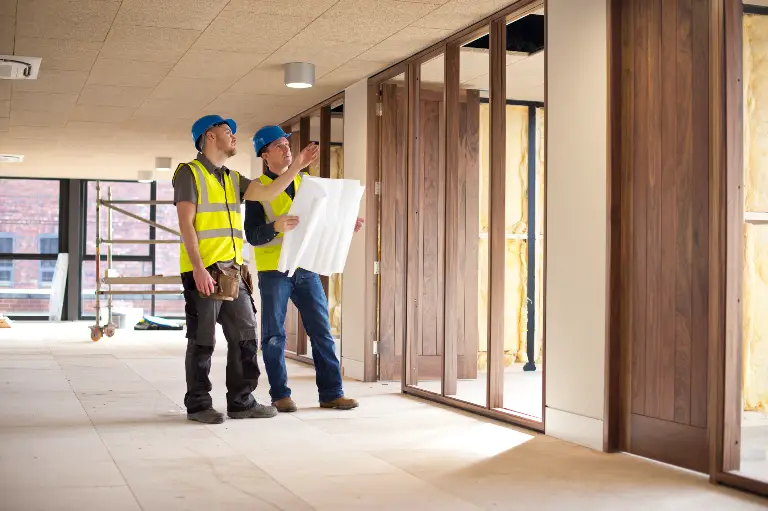
Project Management for Office Fit Outs: Step-by-Step Guide
Project management for office fit outs coordinates scope, cost, compliance and delivery sequencing across every stage. When these stages are not clearly defined, budgets expand, timelines may adjust, and occupation dates will inevitably be delayed.
Clear reporting lines and documented decision points prevent reactive project management and protect financial control. For a definition of the project management office function in practice, see our blog on the role of office project management. Otherwise, for a more extensive overview of office fit outs, visit our complete guide to office fit outs.
This guide details the practical stages required to deliver office fit outs with clarity from briefing through to handover.
Why Early Decisions Determine Project Success
Office fit outs fall under the Construction Design and Management Regulations 2015. The Health and Safety Executive (HSE) confirms that commercial clients influence procurement, appointments, budgets and project timescales [1].
Those early decisions determine contractor performance, sequencing and site safety long before installation begins. Procurement strategy often determines whether risks are controlled or compounded.
Commercial client duties include:
- Appointing competent designers and contractors
- Providing accurate pre-construction information
- Ensuring a construction phase plan is in place
Projects lasting more than 30 working days with over 20 workers on site, or exceeding 500 worker days, must be notified to the HSE.
Stage 1: Defining the Brief & Workplace Strategy
Effective office project design begins with a clearly defined operational brief. Business objectives must translate into spatial, technical and organisational requirements.
Workplace planning typically considers:
- Headcount forecasts and growth projections
- Departmental workflow and adjacencies
- Storage requirements and document retention needs
- Collaboration space, meeting rooms and quiet areas
- Technology and power requirements for teams and systems
Design strategy should support long-term growth and managerial efficiency. A clear scope definition at this stage limits downstream cost variation and programme disruption.
Stage 2: Design Constraints & Building Fabric Reality
Feasibility testing evaluates whether the proposed layout corresponds to the physical limits of the existing building. Many commercial properties were not designed for current occupancy densities or service loads. The Building Regulations Manual confirms that structural alterations, changes to fire strategy, or service upgrades may require formal approval before works begin [2].
Feasibility assessments commonly identify:
- Floor loading restrictions
- Limited ceiling void capacity
- Escape route limitations
- Electrical infrastructure constraints
Fixing these issues before design sign-off prevents redesign and protects the construction timeline. Building works coordination is outlined on our service page of the same name, and where additional floors are required, please visit our structural detail page.
Stage 3: Budget Control & Cost Management
Financial planning should be established before procurement. Office project management defines the approved cost limit and tracks decisions against it throughout design and delivery.
Royal Institution of Chartered Surveyors (RICS) NRM 1 describes cost planning as allocating an agreed budget across building elements, then reconciling that allocation as the design evolves. It also necessitates formal risk analysis instead of applying standard percentage allowances [3].
Cost planning typically includes:
- Professional fees
- Construction works
- Mechanical and electrical systems
- Fixtures and furniture
- Risk and inflation allowances
Stage 4: Phasing & Occupied Workspaces
Many office refurbishments take place while businesses stay operational. Phased delivery planning prevents disruption to staff and service continuity.
Phasing strategies may include:
- Out-of-hours installation
- Temporary relocation of teams
- Split-stage handovers
Where mezzanine floors or partitioning systems are introduced, sequencing must be consistent with certification and reoccupation planning. Careful phasing reduces disruption to staff and maintains operational continuity.
Stage 5: Post-Completion Accountability & Asset Protection
Construction safety obligations extend beyond installation. HSE guidance notes that risk assessments must be recorded and reviewed where five or more employees are involved. It also identifies trips and falls as a leading cause of major construction injuries, with over 1,000 reported annually [4].
At completion, asset documentation should include:
- Fire strategy confirmation
- Electrical certification
- Operation and maintenance manuals
Structured close-out supports facilities management and long-term building performance. Documented project examples can be reviewed on our case studies page. For more information relating to commercial refurbishment, please visit our FAQs.
Speak to Our Office Fit Out Project Management Specialists
Office fit outs require coordinated decision-making across design, construction and compliance. Engaging experienced project managers at the outset improves budgeting accuracy, scheduling certainty and delivery clarity.
Jade Aden Interiors are office fit out specialists with combined commercial experience across multiple sectors. For more details on the team responsible for project coordination, please visit our meet the team page.
Call 01425 689199 or book a consultation to discuss your office fit out with our project management specialists.
External Sources
[1] The Health and Safety Executive (HSE), Construction Design and Management Regulations 2015: https://www.hse.gov.uk/construction/cdm/2015/commercial-clients.htm
[2] GOV.UK, The Building Regulations Manual: https://assets.publishing.service.gov.uk/media/64a59267c531eb000c64ff12/Manual_to_building_regs_-_July_2020.pdf
[3] Royal Institution of Chartered Surveyors (RICS), RICS NRM 1: https://www.rics.org/profession-standards/rics-standards-and-guidance/sector-standards/construction-standards/nrm
[4] The Health and Safety Executive (HSE), Health and Safety in Construction: https://www.hse.gov.uk/pubns/books/hsg150.htm