


The Differences Between Canteen Refurbishment & Renovation

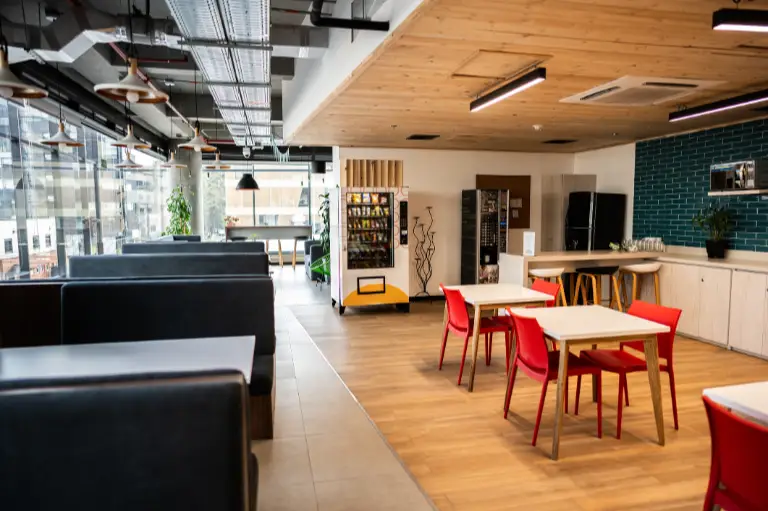
The Differences Between Canteen Refurbishment & Renovation
Misusing the scope of a canteen project is one of the most common reasons commercial works run over budget. The terms refurbishment and renovation appear interchangeably in contractor quotes, facilities plans, and internal briefs, but they describe:
- Different scopes of work.
- Different compliance obligations.
- And different cost profiles.
When the wrong scope is applied, the result is either a cosmetically updated space that still fails operationally or renovation-level spend on a problem a focused refurbishment could have resolved.
This guide is for anyone responsible for planning or approving canteen design and fit out work, from facilities managers working up a brief to operations directors signing off on a budget.
It covers what each scope entails, where the line lies between the two, and how to determine which one your business needs.
What Canteen Refurbishment Scope Actually Covers
Canteen refurbishment works within what already exists. The structure stays, and the services remain largely in place. What changes are the way the space looks, how it functions, and whether it meets the needs of the people using it.
In practice, the refurbishment scope for a commercial canteen usually covers:
- Replacing fixtures, fittings, and surface finishes such as flooring, wall coverings, and counters.
- Updating furniture and seating to reflect current standards or company branding.
- Improving lighting, acoustics, or ventilation within the existing ceiling and services layout.
- Reconfiguring the layout without structural alterations, such as repositioning furniture zones or adding partitioning.
- Refreshing the space’s visual identity through new colour schemes, manifestations, or branded elements.
The Chartered Institute of Personnel and Development’s (CIPD) 2025 Health and Wellbeing at Work report recorded average staff absence at 9.4 days per employee per year, up from 7.8 days in 2023, and identifies canteen provision as part of a structured employee wellbeing framework. A dated or uncomfortable canteen sits outside that framework, and refurbishment addresses this without structural change [1].
Disruption management is comparatively straightforward at this scale. Works can often be phased or scheduled out of hours, keeping the canteen partially operational throughout.
Our canteen and kitchen refurbishment completed at Good Energy HQ shows how a workplace dining environment can be updated as part of a broader fit out, with phased delivery keeping disruption to a minimum. You can also browse our project gallery for other examples of completed refurbishments.
When Canteen Renovation Goes Further Than A Refresh
Renovation involves changing the fabric of the space. This means structural alterations, reconfiguring drainage or gas supplies, replacing building services infrastructure, or restoring a space that has deteriorated beyond what a surface-level refresh can address.
For a commercial canteen, renovation might be triggered by any of the following:
- Structural changes to walls, openings, or the ceiling void.
- Relocation of extract ventilation, gas supply, or drainage to support a new kitchen layout.
- Damp, mould, or structural deterioration requiring remedial building works before any fit out can begin.
- A change of use or significant capacity increase requiring planning or building regulation approval.
- Existing services infrastructure that no longer meets current compliance requirements.
This is where the Construction (Design and Management) Regulations (CDM) 2015 become relevant. The Health and Safety Executive’s (HSE) guidance on CDM 2015 confirms that all commercial construction work carries health and safety obligations for clients, designers, and contractors. Projects must be formally notified to the HSE if they are expected to last more than 30 days with more than 20 workers simultaneously on site at any point, or if they will exceed 500 person days of construction work. Lengthy renovation projects can meet either threshold [2].
Disruption management becomes a more serious consideration at this scale. The canteen is likely to be out of use for the full duration of the works. Watch our project walkthrough videos to see how larger-scale commercial works are planned and delivered.
Alternatively, for an example of large-scale commercial works managed under CDM, our full building refurbishment for Bournemouth and Poole College covers how a complex multi-phase project was planned and delivered within compliance requirements.
How To Decide Which Approach Is Right For Your Canteen
The right way to frame this decision is not as a matter of preference or budget alone, but rather a matter of what the space requires. Applying the refurbishment scope to a space that needs renovation produces a cosmetically improved result that still fails operationally.
The CIPD’s work on productivity and people management, drawing on London School of Economics (LSE) evidence linking structured management practices to labour productivity, makes the case that firm-level workplace factors matter. Committing budget to the wrong type of work undermines that [3].
Before committing to either route, read our complete guide to office fit outs for a clearer picture of the planning process and compliance obligations. A site survey will confirm the condition of the existing building fabric and services, and the team can advise on the right approach before cost planning begins.
The practical questions to work through are:
- Is the building fabric sound, or are there structural or services issues to resolve first?
- Is the current layout operationally viable, or does the space need structural reconfiguration?
- Is the canteen capable of being updated in phases, or does it need to be taken out of use entirely?
Making the Right Call Before the Project Starts
The right scope, confirmed before any work is costed or briefed, produces a canteen that functions as it should, on a programme the business can plan around, at a cost that reflects the actual work required. The difference between refurbishment and renovation cannot be resolved by terminology. It is resolved by a proper site assessment.
Jade Aden Interiors has delivered canteen design and fit out projects across the South of England for over 30 years, including canteen and workplace upgrades in Hampshire, Dorset, Wiltshire, and Sussex. For businesses that need a broader office refurbishment alongside their canteen works, the team manages the full scope under a single contract, as an AIS member and Omega Approved Contractor working to clearly defined quality and compliance standards.
Call 01425 689199 or book a consultation to discuss your canteen project and establish which approach is right for your building.
External Sources
[1] The Chartered Institute of Personnel and Development (CIPD), Wellbeing at Work (2025): https://www.cipd.org/uk/knowledge/factsheets/well-being-factsheet/
[2] GOV.UK, Health and Safety Executive (HSE), What You Need To Know if You Are Doing or Having Construction and Building Work Carried Out: https://www.hse.gov.uk/construction/cdm/2015/buildingcontrol.htm
[3] The Chartered Institute of Personnel and Development (CIPD), Productivity and People Management: https://www.cipd.org/uk/views-and-insights/cipd-viewpoint/productivity-people-management/