


Advantages of Sustainable Development in Office Design

Advantages of Sustainable Development in Office Design
A facilities manager reviewing their energy spend for the third consecutive year is not looking at a utilities problem. They are looking at a design problem, one that was set in place the day the fit out was specified. The advantages of sustainable development in office design are most visible at precisely that point, and our sustainable office design service is built around the specification decisions that determine how a building performs across its working life.
Most commercial offices consume more energy, require more maintenance, and carry more compliance risk than they should. This is not because the organisations in them are careless, but because the buildings were never designed with operational performance in mind. The result is a slow accumulation of costs spread across energy invoices, reactive callouts, and eventual regulatory enforcement.
This article explains where those costs originate and how the right specification decisions eliminate them.
The Real Measure of Sustainable Design Is What It Costs to Run
The built environment accounts for 25% of the UK’s total carbon footprint, according to the UK Environmental Audit Committee. The Government Property Agency’s Sustainability and Net Zero Annex makes clear that achieving meaningful carbon reduction requires both the specification of sustainable materials and systems and sustained performance throughout a building’s life. That figure gives some indication of the operational stakes involved at the design and fit out stage [1].
A building that performs poorly on energy, materials, or systems maintenance costs more to operate, regardless of how its sustainability credentials are presented externally. The office design and build decisions made at the specification stage shape running costs for years. Getting those decisions right from the outset is where the efficiency argument begins.
How Material Selection Determines Lifecycle Costs
The choice of materials at fit out stage has a direct bearing on how much a building costs to maintain over time. The Royal Institution of Chartered Surveyors (RICS) practice information on Life Cycle Costing defines “through life costs” as the cost of financing hard and soft facilities management across the life of an asset, including replacement, redecoration, repair, and both corrective and preventive maintenance. RICS explicitly states that a higher capital cost can be justified if offset by lower maintenance costs over the asset’s service life [2].
For commercial fit outs, this means specifying materials based on durability, repairability, and thermal performance rather than upfront price. Sustainable materials such as low-VOC finishes, responsibly sourced timber, and recycled-content partitioning often offer longer service lives and lower disposal costs.
The result is a measurable reduction in lifecycle expenditure:
- Durable surface finishes reduce redecoration cycles and associated downtime.
- Thermally efficient materials reduce heating and cooling loads year-round.
- Responsibly sourced materials are more likely to meet future regulatory requirements without retrofit.
For a full overview of the partitioning and ceiling systems available, the suspended ceilings and partitioning pages cover the product specifications in detail.
Energy Efficiency Starts at The Specification Stage
Building systems, including heating, ventilation, lighting, and air conditioning (HVAC), account for a significant share of operational running costs in commercial premises. Under current legislation, businesses must hold a valid Energy Performance Certificate (EPC) when renting out, selling, or constructing commercial premises, as set out in GOV.UK’s guidance on EPCs for business premises. Failure to make an EPC available to a prospective buyer or tenant carries a fine of between £500 and £5,000, depending on the building’s rateable value [3].
A fit out that integrates energy-efficient systems from the outset reduces energy consumption from day one rather than requiring costly retrofitting to meet compliance thresholds later. Sensor-controlled lighting, demand-led ventilation, and modern HVAC are all decisions made at the building works specification stage. Reversing them after occupation is significantly more disruptive and expensive than designing for performance at the start.
Regulatory Compliance & the Cost of Falling Behind
The Building Regulations etc. (Amendment) (England) Regulations 2026, confirmed in the Future Homes and Buildings Standards Building Circular 01/2026, introduce new energy and ventilation requirements for buildings other than dwellings in England. These come into force on 24 March 2027, and businesses constructing or significantly altering commercial premises will need to meet the updated standards from that date. The regulatory direction of travel on energy and sustainability is clear [4].
Businesses that address energy performance, ventilation standards, and materials specifications as part of a planned fit out or refurbishment programme spread the cost over a managed timeline. Those who wait bear both the retrofit cost and the disruption caused by unplanned works. Project management that accounts for compliance requirements at the design stage removes this risk, and with a fixed implementation date now in place, the window for planned rather than reactive action is narrowing.
How Sustainable Design Supports Facilities Management
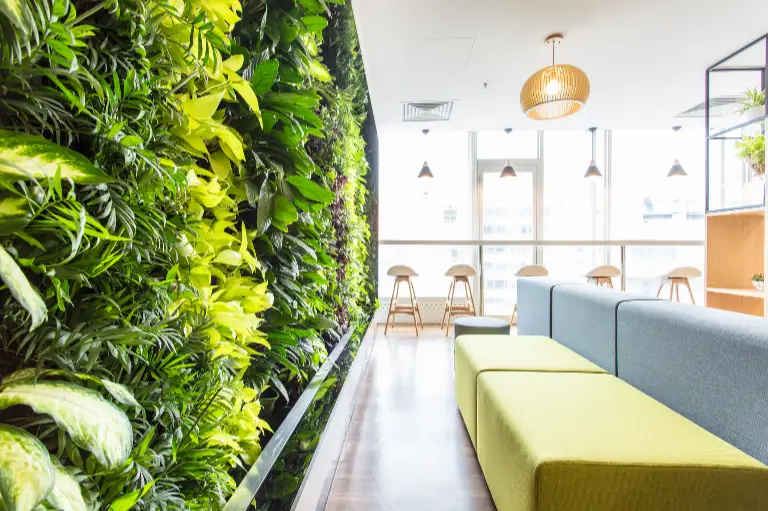
A well-specified fit out reduces the reactive maintenance burden on facilities teams. Buildings designed with durable materials, efficient systems, and considered spatial layouts generate fewer faults, require less frequent intervention, and are easier to manage within a planned maintenance programme. The British Safety Council’s (BSC) 2025 article on biophilic design and workplace wellbeing notes that people spend around 90% of their time indoors, a context in which the quality of the built environment directly affects physical and mental health and productivity.
Natural light, air quality, and access to greenery are each associated with lower stress levels, reduced absenteeism, and better cognitive performance. A building that performs as designed, with systems that run efficiently and materials that age well, places less pressure on facilities management resources. Fewer emergency interventions, lower maintenance cost variance, and spaces that support the people working in them are the practical outcomes of getting specifications right.
These Specification Decisions Pay for Themselves
Sustainability in office design is not separate from operational performance, but one of the mechanisms that determines it. Businesses that approach material choices, building systems, and compliance readiness with lifecycle cost and long-term performance in mind achieve measurable results:
- They reduce operating costs throughout the asset’s life.
- They lower compliance risk before regulatory deadlines force the issue.
- They reduce unplanned expenditure that their facilities teams are asked to absorb.
Jade Aden Interiors is a commercial fit out and refurbishment specialist with over 30 years of experience across the South of England. In addition to being Komfort Registered Contractors, Omega Approved Contractors, and members of the Association of Interior Specialists (AIS), a free site survey and a no-obligation quotation are included as standard parts of the service.
Call 01425 689199 or book a consultation to discuss how sustainable design principles can be applied to your commercial premises.
External Sources
[1] GOV.UK, Government Property Agency (GPA), Sustainability and Net Zero Annex (2024): https://www.gov.uk/government/publications/the-government-workplace-design-guide/sustainability-and-net-zero-annex
[2] The Royal Institution of Chartered Surveyors (RICS), Practice Information, Life Cycle Costing (2016): https://www.rics.org/content/dam/ricsglobal/documents/standards/Life-cycle-costing_1st-edition.pdf
[3] GOV.UK, Energy Performance Certificates for Your Business Premises: https://www.gov.uk/energy-performance-certificate-commercial-property
[4] GOV.UK, Ministry of Housing, Communities & Local Government (MHCLG), the Future Homes and Buildings Standards: Building Circular 01/2026 – Letter (2026): https://www.gov.uk/government/publications/the-future-homes-and-buildings-standards-building-circular-012026/the-future-homes-and-buildings-standards-building-circular-012026-letter
[5] British Safety Council (BSC), a Green and Bright Workplace: How Biophilic Design Boosts Employee Wellbeing (2025): https://www.britsafe.org/safety-management/2025/a-green-and-bright-workplace-how-biophilic-design-boosts-employee-wellbeing