


How to Improve Canteen Interiors in Commercial Workplaces

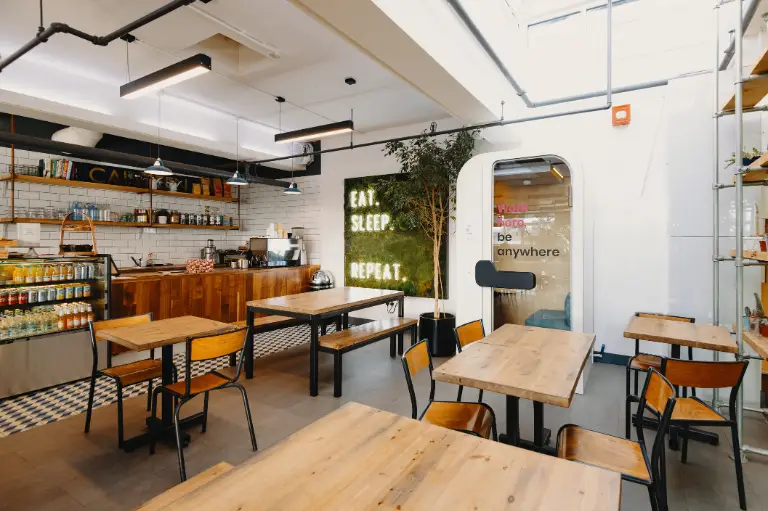
How to Improve Canteen Interiors in Commercial Workplaces
At midday, the canteen fills quickly. Queues overlap with seating, noise levels rise, and staff struggle to find space. Cleaning teams fall behind, and break times become difficult to manage for facilities management teams.
This is a common issue in commercial workplaces that can no longer cope with daily demand, as poor layouts and ageing finishes:
- Increase maintenance requirements.
- Affect hygiene standards.
- Limit how effective use of the space.
Staff canteen design should prioritise flow, durability, and compliance while supporting how people use the space. A well-designed canteen allows staff to step away, recharge, and return to work more focused.
This guide outlines how to improve layout efficiency, specify durable materials, and plan upgrades that support operational performance and staff experience.
Improve Layout & Material Performance in Staff Canteen Design
Effective staff canteen design should be structured around workflow, circulation, hygiene, and long-term maintenance. For a broader look at planning food preparation and service areas, our complete guide to designing a first-rate kitchen for your office covers the practical considerations involved in workplace kitchen layouts.
Government guidance states that catering spaces should follow a defined sequence from delivery and storage through to preparation, service, washing up, and waste disposal to reduce cross-contamination [1].
Layout planning should separate clean and non-clean activities. Routes for deliveries, waste, staff, and users should remain distinct, with clearly defined zones for preparation, service, and circulation. Room dimensions must allow safe movement and support the effective use of installed equipment.
Minimum spacing requirements include:
- 1,200 mm between walls or doorways and equipment or worktops.
- 1,800 mm between adjacent equipment or counters.
- 2,000 mm in higher-risk cooking areas, such as frying or grilling.
Material selection must support hygiene and durability. Recommended specifications include:
- Slip-resistant flooring suitable for wet conditions.
- Easy-clean, low-maintenance surfaces.
- Ceramic tiles or resin flooring in high-use areas.
- Floors laid to drain correctly to prevent water pooling.
These principles support safe operation, reduce maintenance pressure, and ensure the space performs reliably during peak use. Experienced design and build specialists can assess layout efficiency and specify materials that support long-term performance.
Create a Canteen Environment Staff Can Use & Enjoy
Workplace canteens must support more than hygiene compliance. Environmental conditions directly affect comfort, concentration, and how effectively staff can use their break time.
The Health and Safety Executive (HSE) states that enclosed workplaces must have effective ventilation to remove heat, fumes, and vapours generated during cooking. Poor airflow can result in uncomfortable temperatures, fatigue, and reduced working conditions [2]. These issues often require building works and compliance upgrades to ensure systems meet current standards.
Environmental considerations should focus on:
- Maintaining stable temperatures during peak service times.
- Managing airflow to prevent heat build-up in enclosed areas.
- Reducing noise levels in open-plan dining spaces.
- Providing appropriate lighting for visibility and comfort.
The Chartered Institute of Personnel and Development (CIPD) reports that workplace environments influence employee wellbeing, engagement, and productivity across organisations [3].
Practical improvements include:
- Acoustic treatments to reduce noise in hard-surfaced interiors.
- Defined seating zones to manage occupancy more effectively.
- Access to natural light where available.
- Layouts that support short, uninterrupted breaks.
Focusing on environmental conditions supports a space that remains comfortable, functional, and suitable for daily use.
Refurbish Your Canteen Without Disrupting Daily Operations
Canteen refurbishment in an active workplace must be planned in advance, with clear responsibility for health and safety. Under the Construction (Design and Management) Regulations 2015, all parties involved have defined duties that must be addressed before work begins [4].
Projects should account for how the building remains operational, how risks are controlled, and how work is sequenced to minimise disruption.
Typical measures include:
- Phased works to maintain access.
- Out-of-hours installation where required.
- Temporary catering arrangements.
- Clear communication with staff.
- Coordination of mechanical and electrical systems.
Some projects must also be formally notified where work exceeds 30 days with more than 20 workers, or 500 person-days.
This approach ensures refurbishment work is delivered safely while maintaining continuity across the workplace.
Signs Your Staff Canteen Is No Longer Fit for Purpose
Operational issues often indicate that a canteen no longer meets current requirements. Identifying these early allows improvements to be planned before costs and disruption increase.
Common indicators include:
- Recurring maintenance and repair issues
- Congestion during peak service periods.
- Staff feedback, highlighting poor usability.
- Difficulty maintaining consistent cleaning standards.
- Compliance risks linked to layout or facilities.
- Underused space that does not support current demand.
These signs often point to inefficiencies in layout, materials, or environmental conditions. Addressing them early helps control maintenance costs, reduce operational disruption, and maintain compliance standards.
If issues are already affecting maintenance costs, it can also help to review wider building maintenance priorities before problems escalate. Our building maintenance checklist for facilities managers gives a useful overview of what to monitor.
Design a Staff Canteen that Works Every Day
A well-planned staff canteen supports daily operations, simplifies maintenance, and provides a reliable space for staff to use throughout the working day. Improvements should be based on how the space performs under real conditions, not short-term adjustments.
Jade Aden Interiors designs and delivers staff canteen fit outs across Dorset, Hampshire and the South of England. Each project is planned around operational requirements, ensuring the space supports both staff use and facility management without unnecessary disruption.
Call 01425 689199 or book a consultation to improve your staff canteen design with a practical, fully compliant refurbishment plan.
External Sources
[1] GOV.UK, Ministry of Defence, Design & Maintenance Guide 18, Design of Catering Facilities: https://assets.publishing.service.gov.uk/media/5a79cf68ed915d042206b322/20121220-DMG_18_2011_Rev_Dec_12-U.pdf
[2] The Health and Safety Executive (HSE), Ventilation of Kitchens in Catering Establishments: https://www.hse.gov.uk/pubns/cais10.htm
[3] The Chartered Institute of Personnel and Development (CIPD), Health and Wellbeing at Work: https://www.cipd.org/uk/knowledge/reports/health-well-being-work/
[4] The Health and Safety Executive (HSE), What You Need to Know if You Are Doing or Having Construction and Building Work Carried Out: https://www.hse.gov.uk/construction/cdm/2015/buildingcontrol.htm